There is a moment when a thought trembles, silently—never enough to become a word. Just a vibration crossing the room, lingering for an instant, then fading. But before it disappears entirely, that thought brushes against surfaces, weaves itself into textures, clings to every fiber. It remains there, where no one can see it. It merges with matter, with the sand slipping slowly downward, drawn by gravity, among passing shadows. Even when a person is no longer there, even when the gesture dissolves, those thoughts remain.
Not enough thought, not enough word, not enough movement to truly reveal, to narrate, to preserve what has been. The presence of male garments, deliberately chosen, constructs a symbolic and delicate barrier. The artist reflects on the historical weight of patriarchal power, which over time has rendered women’s labor, gestures, and presences invisible, often diminished.
The fabrics, emptied of bodies, vibrate and release memory, like shells that preserve yet cannot fully contain the complexity of the lives that passed through them.
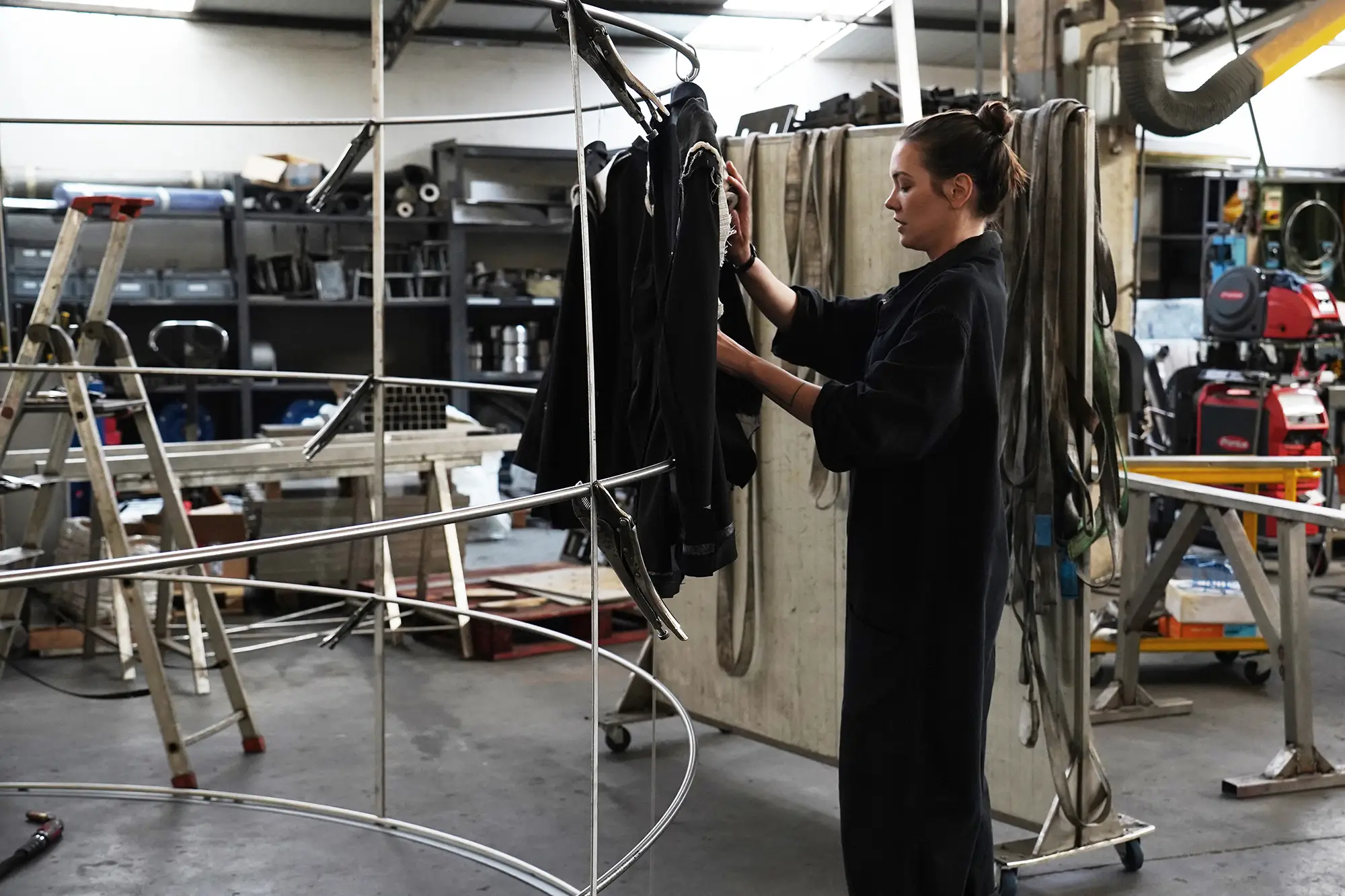
In this work, however, textiles are not mere scenic elements. They have been dismantled, opened, manipulated to reveal their internal structures: seams, padding, linings, reinforcing canvases—everything that usually remains hidden from view. Each intervention on the materials brings to light the invisible labor beneath every formal construction. It is an act of unveiling that echoes the lives and work of women historically confined to the margins of narrative. Again and again, in the history of women’s contribution to textile production, their role has been essential yet often concealed, stitched into shadow, taken for granted. It has dispersed into the invisible weavings of places and people that have shaped reality. Yet places are defined by people, and people carry memory.
The work thus becomes an act of intimate archaeology, where matter itself turns into narrative and quiet inquiry. Embroidery, in particular, takes on an additional meaning: it reflects a mapping the artist traced of the space, based on the marks left on the floor by labor within the rooms of the filanda. Each thread, each stitch, becomes a line of connection between past and present, transforming the textile into an emotional and historical cartography.
The artist’s movement within the space, intertwined with the sand and the trembling of the textile installation, is not only composed of physical gestures, but is an attempt to give form to elusive thoughts—thoughts that flow into memory, into labor, into relationships that have silently shaped not only individual identities, but the collective identity of the community.
Thoughts traverse a time that cannot be stopped, leafing through lives like pieces of fabric, one by one. It opens them, turns them over, follows their frayed seams and worn edges, as if searching for a thread to tie again, or a story to hold before it slips away—before memory ceases to belong. Thoughts return, whirl, disperse. And yet they remain, within every fiber, held in the silence of what once had the courage to tremble. Invisible and present, like everything that has been deeply lived yet never fully understood, leaving a trace—light as silk—within the weave of time.